How to improve your running with a simple training block
Learn how to plan a simple four-week running training block, choose the right mix of easy runs and quality sessions, and send structured workouts to Garmin with RunSync.
Most runners do not need a complicated training plan.
They need a sensible one they can actually follow.
That usually means consistency, enough easy running, one or two focused workouts, and a clear reason for each session. The hard part is not understanding that structure helps. The hard part is turning the plan into actual runs when the week gets busy.
RunSync is built for that gap:
Set the block. Put the workouts on the calendar. Let the right session appear on your Garmin when it is time to run.
What is a running training block?
A training block is a focused period of training, usually four to eight weeks, where your running has a clear purpose.
That purpose might be to build consistency, improve 5k speed, prepare for a 10k, return after time off, or build general aerobic fitness.
The benefit is simple: a block stops every week becoming random.
Instead of asking “what should I run today?”, you already know the job of each session.
Simple block structure
- Length
- 4 weeks
- Focus
- Build consistency and controlled quality
- Pattern
- 3 build weeks, then 1 easier week
- Goal
- Repeatable training, not one heroic workout
That does not mean every run has to be hard. Most runners improve better when most of their running is easy, with a small amount of harder work placed carefully in the week.
The four ingredients of a useful week
For many runners, a useful training week has four basic ingredients.
Easy running
Easy runs build your aerobic base. They should feel controlled and repeatable. You should finish feeling like you could have done more.
These runs are not filler. They are the foundation that lets you handle harder sessions.
One quality session
This might be intervals, hills, tempo running, threshold work, or a progression run.
The point is not to destroy yourself. The point is to introduce a clear training stimulus that helps you improve.
Example quality session
- Warm up: 10 minutes easy
- Repeat 5 times: 3 minutes strong, then 2 minutes easy
- Cool down: 10 minutes easy
That is exactly the kind of session that is easier to follow when the workout is already on your watch.
A longer run
The long run helps build endurance, confidence, and durability.
It does not need to be fast. For most runners, keeping it comfortable is the right choice most of the time.
Recovery
Improvement happens when your body adapts to training. Rest days, easier days, and backing off when needed are part of the plan, not a failure of the plan.
Example four-week running block
A simple four-week block could look like this:
Here is what that might mean in practice.
Week 1: Establish rhythm
- Easy run
- Short interval session
- Easy run
- Long easy run
The first week is about starting cleanly. Do not try to prove fitness on day one. Choose sessions you can complete with control.
Week 2: Build slightly
- Easy run
- Tempo or threshold session
- Easy run
- Slightly longer easy run
The second week nudges the training forward. That might mean a little more quality work, a slightly longer long run, or a more specific workout.
Week 3: Peak the block
- Easy run
- Interval session
- Easy run
- Long run with a steady finish
This is usually the biggest week of the block. Bigger does not have to mean reckless. The goal is to complete the work and still be able to recover from it.
Week 4: Absorb the work
- Easy run
- Lighter quality session
- Easy run
- Reduced long run
The lighter week gives your body a chance to absorb the previous training before you start the next block.
This is where many runners go wrong. They keep adding more because the plan is working, then wonder why the next few weeks feel flat.
The hard part is following the plan
Most runners can write a decent plan.
The harder part is following it when real life gets involved.
A good plan often breaks down because of friction:
- The workout is written down but not on the watch.
- The interval structure has too many steps to remember.
- The session is awkward to enter manually.
- The runner forgets what was planned.
- The week changes and the plan is not updated.
This is where RunSync helps. Instead of creating workouts one at a time and deciding when to use them at the last minute, you can plan the block first.
You create the workouts, place them on a calendar, and build the next few weeks before the week gets busy.
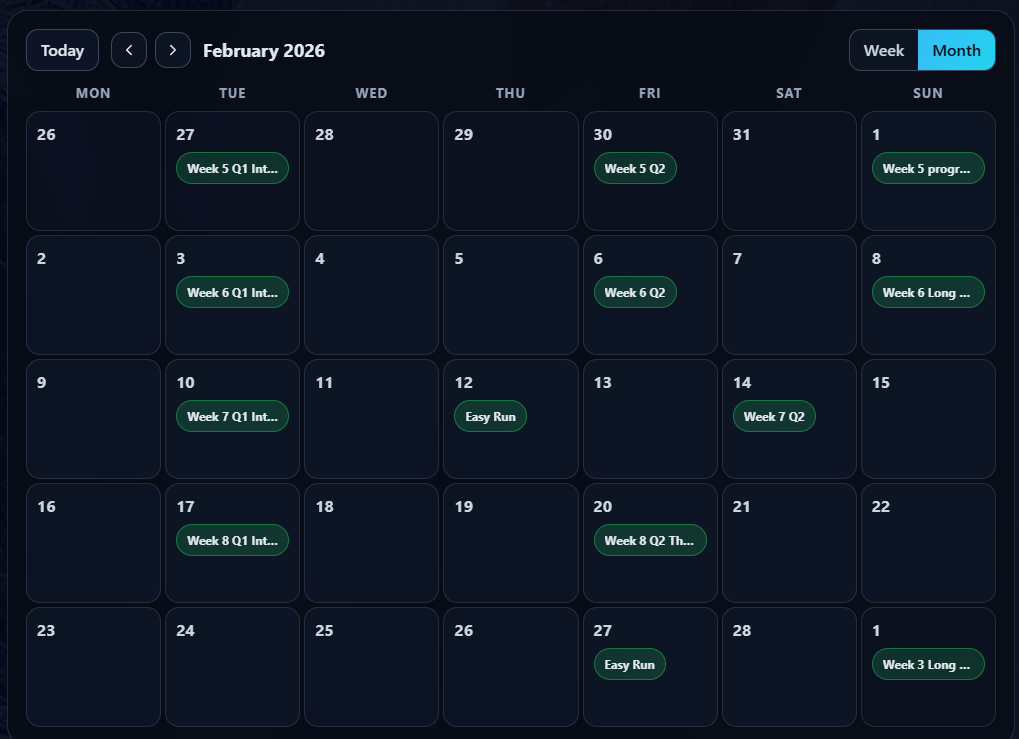
Plan the block, then send workouts to Garmin
The RunSync calendar makes structured training easier to follow.
You can plan workouts across the next block, schedule them for the right dates, and send them to Garmin when Garmin is connected.
That means a week can be planned like this:
- Tuesday: Intervals
- Thursday: Easy run
- Friday: Tempo
- Sunday: Long run
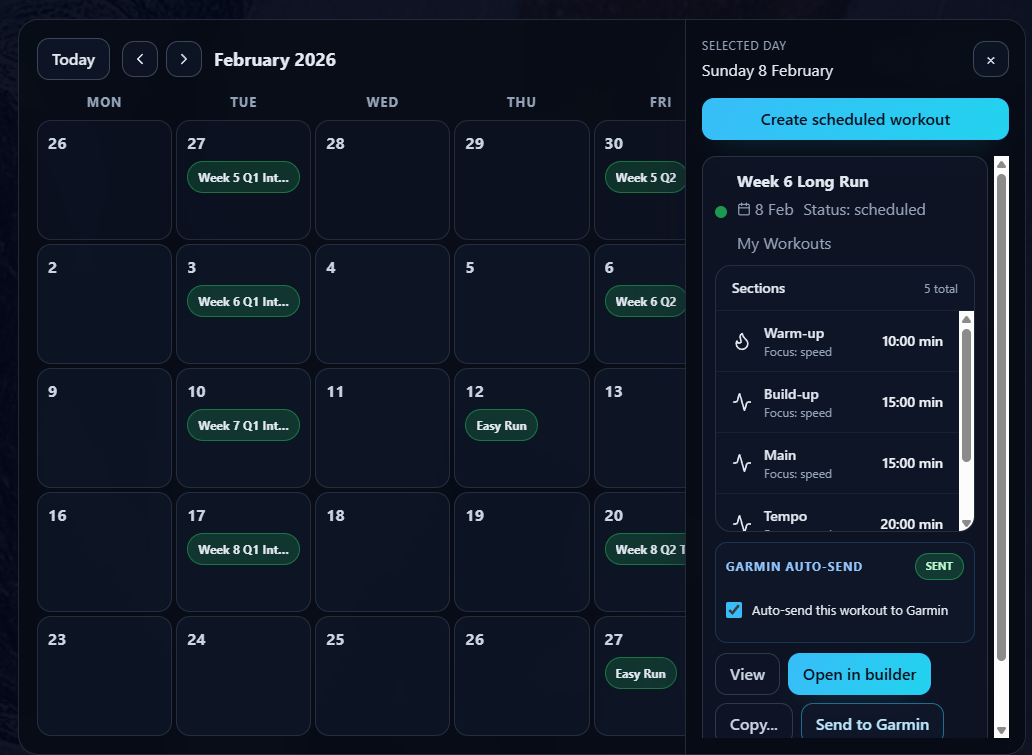
If the workout is already on your watch when you need it, there is less friction. No last-minute setup. No rebuilding interval sessions before heading out. No trying to remember the plan mid-run.
Just open the workout and start.
For the exact Garmin workflow, see how to sync a structured workout to Garmin from RunSync.
Keep the block realistic
A simple block works best when it is honest.
Do not plan the week you wish you could run. Plan the week you can repeat.
Before you schedule the next block, check:
- How many days you can realistically run.
- Where the harder session fits without crowding recovery.
- Whether the long run leaves you able to train the next week.
- Whether your pace targets match your current fitness.
- What work, sleep, travel, or family commitments will affect training.
Pace targets matter here. If your fitness has changed, update the targets before you build the next set of workouts. The guide to using your latest training paces explains why that keeps structured sessions more useful.
A better way to stay consistent
The goal is not to make running more complicated.
It is the opposite.
RunSync exists to make structured training easier to plan, easier to repeat, and easier to follow.
You should be able to sit down once, plan the next few weeks, and trust the system to help you execute.
Set the block. Sync the workouts. Run the plan.
That is where real improvement starts: not from one perfect session, but from weeks of sensible training done consistently.
For a more personal example of this weekly loop, read how I use RunSync to plan my running week.
Ready to plan your next training block?
Create your workouts in RunSync, add them to your calendar, and have them ready on your Garmin when it is time to run.
Start planning with RunSync