How to turn a recent 5k into useful training paces
Use a recent 5k result to estimate practical training paces for easy runs, threshold work, intervals, and faster reps, then apply them in RunSync workouts.
A recent 5k is one of the simplest ways to check where your running fitness is right now.
It is long enough to show your aerobic strength. It is short enough that most runners can race it, time trial it, or use a hard parkrun-style effort without needing a long recovery block afterwards.
That makes it useful for setting training paces.
Not perfect. Not permanent. But useful.
If you know what you can run for 5k today, you have a better starting point for the paces you should use in your structured workouts tomorrow.
Why a recent 5k result works
Training paces should reflect your current fitness.
A 5k from two years ago is probably not the right input. A personal best from a perfect race might also be too aggressive if your recent training has been inconsistent.
What matters most is a result that represents where you are now.
That could be:
- A recent 5k race.
- A hard solo time trial.
- A local parkrun-style effort.
- A controlled benchmark run.
- A coach-prescribed test session.
The result does not need to be perfect. It just needs to be honest enough to guide your training.
Start with the result, not the goal
It is tempting to set training paces from the runner you want to become.
That usually backfires.
If your current 5k fitness says one thing, but your workouts are built around a much faster goal, the sessions can become too hard to repeat.
One big workout might feel good. Several weeks of overreaching usually does not.
A better approach is to start with your current result, train at paces that make sense, and then update those paces as your fitness changes.
That keeps your workouts challenging without making every session a test.
What paces can a 5k help estimate?
A 5k result can help estimate a range of training paces, not just one race pace.
RunSync’s training pace tools estimate pace bands from a race performance, including the kinds of zones runners commonly use for structured workouts:
Useful pace bands
- Easy
- Recovery, aerobic running, and controlled weekly volume
- Threshold
- Strong but sustainable work that should not become a race
- Interval
- Harder repeats, often lasting a few minutes at a time
- Repetition
- Shorter faster reps where relaxed form matters
The point is not to run every workout at 5k pace.
The point is to use your 5k result to create more appropriate targets for different types of training.
How to use a 5k result in RunSync
In RunSync, you can enter a recent race distance and finish time into the training pace calculator.
For a 5k, the workflow is simple:
- Open the training paces tool.
- Choose 5 km as the race distance.
- Enter your finish time.
- Review the estimated training paces.
- Use those paces when building structured workouts.
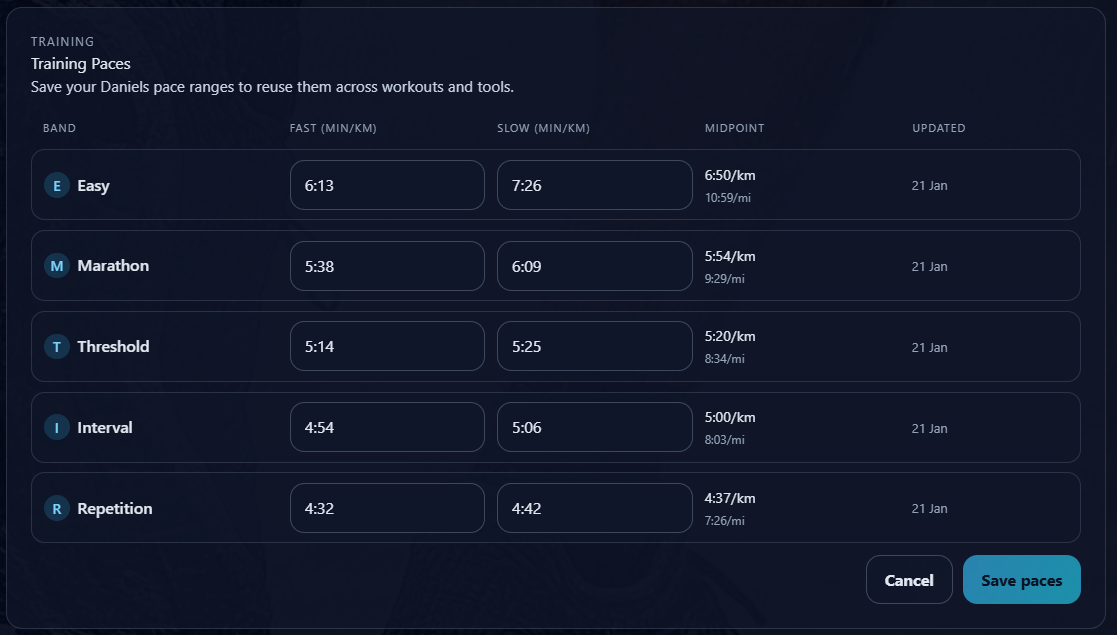
Signed-in Basic and Pro runners can save training pace bands for reuse. That means you do not have to re-enter the same numbers every time you create a workout.
If you want the broader explanation, read why running workouts should use your latest training paces.
What this looks like in a workout
Say you recently ran a 5k and used that result to estimate your current paces.
You might then build a threshold workout like this:
Threshold workout
- Warm up: 10 minutes easy
- Repeat 3 times: 8 minutes at threshold pace, then 2 minutes easy recovery
- Cool down: 10 minutes easy
The structure is simple.
The important part is that the pace targets match your current fitness, not an old race result or a hopeful goal pace.
For intervals, the same idea applies:
Interval workout
- Warm up: 15 minutes easy
- Repeat 6 times: 3 minutes at interval pace, then 2 minutes easy recovery
- Cool down: 10 minutes easy
The workout should be hard enough to create a training effect, but realistic enough that you can complete it cleanly.
Do not treat estimated paces as a rulebook
Training paces are guides.
They are not commands.
Weather, terrain, fatigue, sleep, stress, and recent training all matter.
If your watch says threshold pace but your legs say you are already racing, back off. If it is hot, windy, hilly, or you are coming back from illness, the right pace might be slower than the estimate.
That is not failure. That is training.
The value of calculated paces is that they give you a sensible starting point. You still get to use judgement.
When should you update your paces?
You do not need to update your paces every week.
That can make training noisy and reactive.
Useful times to update include:
- After a recent race.
- After a planned time trial.
- At the start of a new training block.
- After returning from illness or injury.
- When several weeks of training clearly feel too easy or too hard.
For many runners, updating every training block is enough.
The goal is to keep your workouts aligned with your current fitness without constantly chasing tiny changes.
Build the workout, then send it to Garmin
A good workout is not just a hard workout.
It is a workout you can run as intended.
That means the structure should make sense, the recoveries should be realistic, and the paces should match the purpose of the session.
A recent 5k can help with that:
- Use the result to estimate practical training paces.
- Build workouts around those paces.
- Schedule the session in RunSync if you are planning ahead.
- Send the workout to Garmin.
- Run the session without doing maths halfway through.
For the final step, the Garmin guide explains how to sync a structured workout to Garmin from RunSync.
Ready to turn your 5k into training paces?
Use RunSync to calculate practical training paces from a recent race or time trial, then build structured workouts with targets that match your current fitness.
Calculate your training paces